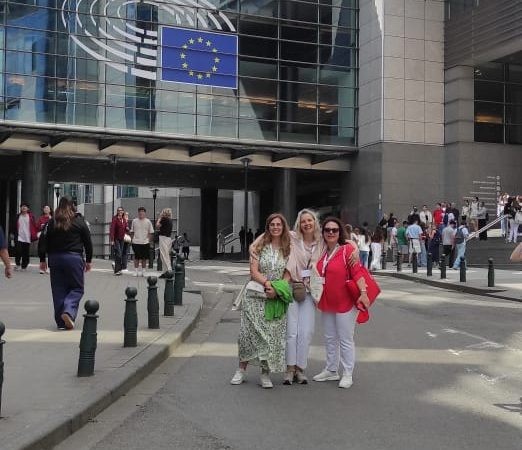
During EU Demos summer school in Brussels, Sara Bertolli (CesUe) interviewed the Eu Demos coordinators for Escola Secundária de Amarante: Laura Pinheiro and Cristina.
What was the most meaningful moment of the EUDEMOS project for you?
Laura: “For me, it was really this mobility. If I could choose one moment, it would be the first day we visited the European Commission. It was very emotional because we were in the heart of European democracy. It’s a place I had always dreamed of visiting. I felt proud to be there with my students and to give them the opportunity to learn more about our shared history. It was a very enriching experience.”
Do you think your students’ perception of the EU changed thanks to this experience?
Laura: “Yes, absolutely. Before, we knew we were part of the EU and that its policies affected our lives, but being there strengthened this feeling. There was an emotional connection that brought us closer. For the students, it’s hard to know to what extent their opinion changed, but I am sure they now feel more aware that they don’t belong only to their town or country, but to something bigger.”
Which EU-related topics do you find most urgent to teach your students?
Laura: “One important issue we discussed was voter abstention, which is a huge problem in our country, especially during European elections. We debated this and how crucial it is to fight against apathy. Many people take for granted their right to vote, but our ancestors fought for this right. We must make students aware of the importance of voting and being heard.”
Would you suggest any improvements for a project like EUDEMOS?
Cristina: “One student suggested having more opportunities for discussions and sharing ideas. More interactive moments could enhance the experience. I think that’s a great suggestion.”
Would you like to participate in similar projects in the future?
Cristina: “Definitely. Our school already takes part in several Erasmus projects. We would love to continue as partners, though not as coordinators since that is hard work. These projects give students opportunities to travel, learn about other realities, and reflect on issues from a global perspective. For example, during course sessions, we analyzed gender inequality and violence against women, seeing how different countries approach these issues. It helps students understand their own and others’ realities.”